You’ve tried everything to fix your sleep? Stop guessing and start assessing!

Calm woman lying in bed at night, eyes open, reflecting sleep struggles and the need for personalized nervous system assessment.

Magnesium. Breathwork. No screens after 9.
Journaling. Meditation. Expensive pillows.

Some nights, those things helped.
Most nights… not really.

They still wake up groggy.
Drained.
Like a zombie in a productivity costume.

Why?

Because trying everything is like throwing spaghetti at the wall and hoping one thing sticks.

I get it. They just want the pain to stop:

The pain of sleep deprivation.
The pain of no energy.
The pain of brain fog.
The pain of zombie mode.

Here’s what most people miss:

Most tools fail because they don’t match what your nervous system actually needs.

This is not assessing.
It’s guessing.

This is where assessment changes everything.

When I guide a client through their first sleep or energy assessment, we start testing how their nervous system actually responds, in real time.

  • Where your nervous system feels unsafe to rest
  • Which sensory systems are overloaded or underused
  • How their body reacts to breath, light, and movement
  • What brings your system back to balance and what throws it off

These assessments give us real-time data from your body.

They help us stop guessing and start building a truly personal plan for better sleep and energy.

So if your healing feels like a mystery…
It’s not that you’re not trying hard enough.
Your body’s just waiting for you to listen better.

Want to find out what your nervous system is actually asking for?

👉 Book your free intro call here

– Michi
Calm Isn’t the Goal of Nervous System Regulation

Soft ocean horizon with the words “Regulation ≠ Calm” overlayed—visual metaphor for nervous system balance and adaptability.

Regulation isn’t the same as relaxation.
Nervous System Regulation Isn’t Just Calming Down. It’s About Shifting Gears.

It’s about adaptability.
The ability to shift gears,
— up or down —
based on what life is asking of you.

Sometimes that means slowing down, finding stillness, and resetting.
Other times? It means mobilizing energy, focus, and drive, without tipping into anxiety or burnout.

I’ve seen this over and over again in high performers, athletes and entrepreneurs. They try to force energy when their system is running on empty.
They rely on willpower in a low state when what they really need is a state shift.
A recharge or a re-center before hitting the gas again.

One thing I tell some clients:
You don’t need to calm down.
You need to build capacity so energy flows from a full tank, not from depletion.

True nervous system regulation isn’t about staying calm.
It’s about being flexible. Adaptable. Responsive.
You don’t have to be chill 24/7.
You just have to know when and how to shift.

That’s what builds resilience.
That’s what unlocks sustainable performance.

Where in your life are you forcing energy… instead of shifting state?

Let me know in the comments.

– Michi

“No Pain, No Gain” Nearly Broke Me

I used to believe pain meant progress. No pain, no gain — right?

That belief wasn’t just a common belief. It was personal.

I grew up training surrounded by men. I was a ski racer.
Later, I studied sports science.
Everything around me screamed: push harder, go faster, tolerate more.

So I did. Until my body broke.

But pain didn’t make me stronger. It numbed me out.
My body whispered its warnings through cramps and tightness.

I didn’t listen. So it screamed.

After an Ultimate Frisbee tournament, I tore several muscle fibers in my left thigh.
I couldn’t walk. Before the MRI, they thought the whole muscle was gone. It turned out it was “just” the half.

More than four months of rehab followed.
I still have a valley in my leg where the fibers never fully grew back.

This injury didn’t come out of nowhere.
I ignored the signals, because I thought I had to push hard. I had trained myself to disconnect from my body’s signals.

That injury became a turning point.

I realized: real performance isn’t built on override mode. It’s built on presence.
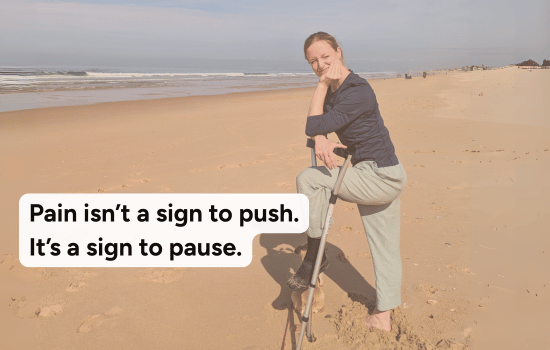
Pain isn’t a sign to push. It’s a sign to pause.

Recovery, rest, and regulation aren’t optional.
They’re strategic.

And I carry that lesson with me every day, in my work, my coaching, and my left leg.

Today, I train differently. I pay attention to the whispers, not just the screams.
I focus on recovery as much as performace. Because pain isn’t proof you’re growing, it’s often proof you’re ignoring something essential.

This is one of the key shifts I guide my clients through.
Because presence beats pressure. Every time!

Curious what that could look like for you?

Lets chat.

– Michi

Sleep Isn’t a Light Switch. It’s a Dimmer.

Most people treat sleep like a light switch. One second you’re working in full hustle mode, the next you expect to be asleep.

But your nervous system doesn’t flip like that.
You can’t drive 150 km/h and just slam the brakes. Same with your brain.

Have you ever found yourself hustling on your laptop late at night?
Finishing one last email, tweaking one last offer, scheduling one last post?
And then… straight to bed.

No pause. No breath. No buffer.
You close the laptop and hope your body instantly shifts into rest mode. But it doesn’t, because you’re still in “doing” mode.

The brain needs a bridge.

A gentle transition from high gear to low.
From tension to release.

Think of it like walking from one room to another. The door in between matters. You take a breather before opening the next door.

That’s your transition phase. A built-in dimmer that slowly lowers activation and invites your system into rest.
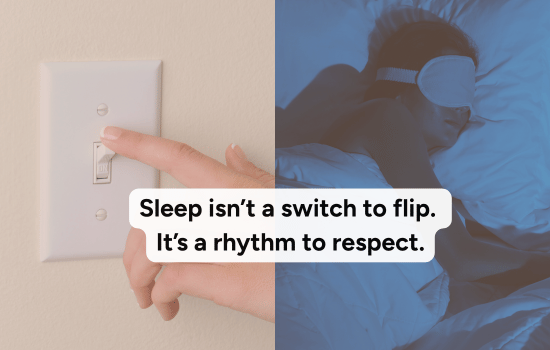
Sleep isn’t a switch to flip. It’s a rhythm to respect.

Do you have a transition phase? What signals your body that it’s time to shift?

I would love to hear what works for you. Please share what it’s like below.

– Michi

Last night I did everything wrong. And I still woke up with clarity. Here’s why.

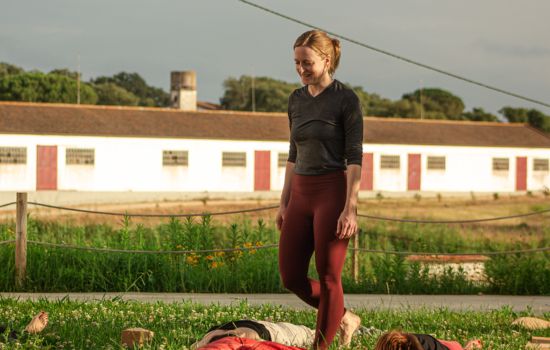
Sleep and neuro performance coach teaching a calming outdoor yoga class, representing energy recovery and nervous system awareness after a restless night.

It’s Better to Feel Like Crap and Know Why
…than feel like crap and have no idea what’s going on.

Just yesterday, I have to confess:
I did everything wrong if I wanted a restful sleep.
But I didn’t wake up asking myself:

  • “Why don’t I have energy?”
  • “Why do I feel groggy and brain-foggy?”
  • “Is it happening again…?”

I did NOT.
I knew exactly why. And honestly? That made it easier to handle.

Here’s what happened:
I had 3 movement classes to teach that day.
One online meeting. I was hustling last minute to get to the classes.
I procrastinated on emails, admin, and writing my blog post.
I snacked on sweets throughout the day.
At least I had a healthy lunch.

The last session finished at 8pm. I didn’t bring water — my bottle smelled bad.
It was 30°C outside.
Still, I went by bike, a bit uphill. No water.

I taught an outdoor class.
Came back home and opened my laptop.
I still had to finish my blog post.

I wasn’t in a good state to write.
Got distracted while researching over and over again.
Still no blog post finished.

Usually, I go to bed at 22:00.
It was already 23:04. I watched the clock repeatedly and stressed about it.
I didn’t wear my blue light blockers.

In the end, I went to bed around midnight.
Guess what?

I couldn’t fall asleep right away.
I was too activated.

Racing thoughts. Worries. All the usual stuff came up. I used my neuro strategies.
Eventually, I fell asleep.

I woke up today and felt like shit.
But it wasn’t that bad.
Because I knew why.

And because I knew why, I knew what to do differently today.
I knew what to do to get my energy back.

We all fail at some point.
But the real question is:
What will you do about it?

If you want to find the root cause of your struggles with energy, let’s talk strategy.

Book your free call.
– Michi

Jet Lag Is Not Inevitable. It’s a Nervous System Challenge You Can Prepare For.

Business traveler with suitcase at airport window watching sunrise and airplane take off – symbolizing jet lag, travel fatigue, and circadian rhythm reset.

Most people treat jet lag like bad weather, annoying, unavoidable, and something to just “push through.

You don’t need to be wrecked after a long flight.

Jet lag isn’t just about time zones, it’s about what your nervous system needs to adapt and recover.

Here’s what I teach my high-performing clients who travel often.

Jet lag happens when your internal clock (circadian rhythm) gets out of sync with your new environment.

But with the right inputs light, timing, movement and rest you can support your brain and body to adapt faster. And that’s a game changer for anyone who travels for work and needs to perform on the go.

  1. Use light as your reset button.
    Your brain uses light to tell time. Get bright sunlight in your eyes first thing in the morning at your destination. It’s the fastest way to realign your internal clock.

  2. Pre-adjust your sleep.
    Shift your sleep/wake times a few days before flying. Even a small adjustment can make your body adapt more smoothly.

  3. Support circulation and hydration.
    Flying dehydrates you and reduces blood flow. Drink water, eat light, and move regularly.

You don’t have to “push through” jet lag. You just need to understand how your body clock works and help it adjust instead of override it.

Want to learn how to travel without crashing your energy and performance?

Let’s chat.

Book your free call.

– Michi

How Blocking Blue Light All Day Can Wreck Your Energy

Young man outdoors wearing stylish yellow-tinted blue light blocking glasses, adjusting his frames in natural daylight.

I know, those yellow, orange, or even red lenses might look fancy at the moment.

You can see it all over socials.

But wearing them all day?
That might be messing with your energy more than helping it.

Blue light isn’t the enemy. It’s part of the natural light spectrum.
You need it in the morning and throughout the day to feel alert, focused, and synced with your environment.

You want to see the lion before it sniffs at your shoulder.

Light input directly impacts your circadian rhythm, which is your internal clock that regulates everything from hormone release to sleep-wake cycles to energy levels.

Block that light for too long during the day?
You confuse your brain.

Instead of giving it the signal: “Hey, it’s daytime, let’s be alert,”
You give it the message: “It’s dusk. Time to wind down.”

So what happens next?

Your energy drops. Your cortisol rhythm shifts. Your sleep gets off.
And you might feel even more tired, foggy, or alert at night.

Basically, the exact opposite of what you were aiming for.

Blue blockers aren’t bad. They’re a useful tool.
But like every tool, timing, assessment and dosage matters.

Use them 1–2 hours before bed.
Or if you’re on screens after dark.

Protect your rhythm.
Your brain performs best when it knows what time it is.
And your brain tells the time through light. Sunlight. The full spectrum. Especially in the morning.

Curious how your environment is shaping your energy and sleep more than you think?

Let’s chat. Book a free call.

– Michi

Mouth Taping for Better Sleep: This Is Happened When I Tried It

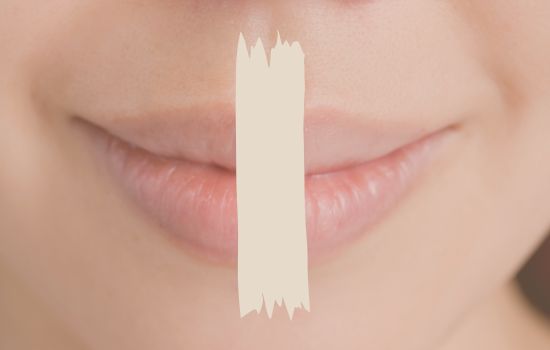
Closed lips with a tape vertically on it to stay closede during sleep.

Do you ever wake up with a dry mouth, sticky tongue, and that not-so-fresh breath?
I thought it was because of the winter air, until it happened in Portugal’s humid climate too.

Turns out, it wasn’t the dry air.
It was a scream from my nervous system.

Looking back, I’ve had this issue since childhood. I even remember asking my mom, when I was little, why my mouth felt so dry when I woke up.
Her advice? “Hang up a wet towel in your room.”
She meant well. But the problem wasn’t the air.

It wasn’t until I went deeper into respiration, applied neurology, and sleep science that things started to click.

A coach I trust mentioned mouth taping.
At first, I thought, “What? Tape my mouth shut? That sounds insane.”

And then survival mode kicked in:
“But what if my nose gets blocked and I can’t breathe?”

He said, “Your brain is smarter than that. It’ll wake you up. You won’t suffocate.”

So I tried it.

Not full-mouth tape. Just a small vertical strip.
Enough to guide my body back into nasal breathing without blocking airflow completely.

That night, I didn’t wake up with a dry mouth for the first time in weeks.
I actually felt rested.

Since I am doing it since years, I can tell it is a gamechanger. If I don’t have the tape with me if feel the difference every time.

Here’s the thing:
Mouth breathing is a stress signal. Your mouth is for food, not for breathing.
It dries out your airways, activates your stress response, and interrupts deep sleep.

Nasal breathing?
It calms your system, filters air, boosts oxygen delivery, and tells your brain, “You’re safe.”

Taping isn’t magic. But it’s a simple push in the right direction, toward a rhythm your body already connects with rest.

Sometimes the smallest tweaks make the biggest difference.
Your body is made for healing when you give it the right conditions.

Curious if your sleep struggles are tied to your nervous system?
Let’s find out together. Book a free call.

– Michi

Disclaimer: This isn’t medical advice — just something that worked for me. Always check with your body (or your doctor) before trying new tools.
Curious about how your own sleep could improve? Happy to chat.

Your Nervous System Will Speak. If You Don’t Listen, It Will Scream.

Ever caught yourself optimizing every single minute of your day? Even a quick walk to the supermarket?

I spoke with a high-level manager who used to do exactly that. Calls on the way to the grocery store. Emails while brushing his teeth. No moment left unoptimized.

But he didn’t tell me this with pride.

Not anymore.

Because now he is facing serious health problems. His nervous system isn’t whispering anymore; it’s screaming. He lost part of his vision. Yeah, he really did.

You might wonder: what does vision have to do with any of this?

Here is what most people don’t know: Your brain’s number one job is survival. Your vision sits at the top of your brain’s survival priorities.

Why?
Because if there’s a bear in the woods, you want to see it before you feel it on your shoulder.

When your nervous system is stuck in overdrive and never resets, your brain will send stronger and stronger signals. At first, it’s some weird back pain. Then maybe digestive issues. Maybe sleep problems. And eventually, it is complete shutdown.

Your brain isn’t trying to ruin your life. It’s actually trying to save it.

Because survival comes first. Performance comes second.

And here’s the part we forget: Focus. Creativity. Clear decisions. All of those are high-level outputs of a regulated system. You can’t access them in a state of constant overload.

Your nervous system will adapt and compensate until it can’t anymore.

If you want to perform at a high level without breaking down, don’t start with outputs, like treating the symptoms.
Start with the root cause and the system that runs it all:

Your nervous system.

Want to learn how?

Book a free call.

– Michi